Drilling techniques
Customised drilling

Photo: Yellow drilling vehicle with drilling device in the mountains
© PORR AG

With many years of expertise and the use of modern drilling technology, we support construction and infrastructure projects with a variety of drilling methods. Our range of services includes geothermal probes for the use of geothermal energy, exploratory drilling to investigate the subsoil, and well drilling for water extraction. The work is carried out precisely, efficiently and in accordance with technical and official requirements.

Drilling techniques

Geothermal probes
Cost-effective energy from the earth

Environmentally friendly energy sources are more in demand than ever. Geothermal energy is particularly popular. At a depth of around ten metres, the temperature remains virtually unchanged throughout the year. This geothermal energy can be used for sustainable heating in buildings.
Erdwärmesonden

Your path to geothermal energy

We have summarised the individual steps for you, from the initial idea to handover and various services. The experienced team at Nägele Hoch- und Tiefbau will be happy to assist you with planning and the necessary subsidy processing, which is advantageous for you.

Earth probe drilling process

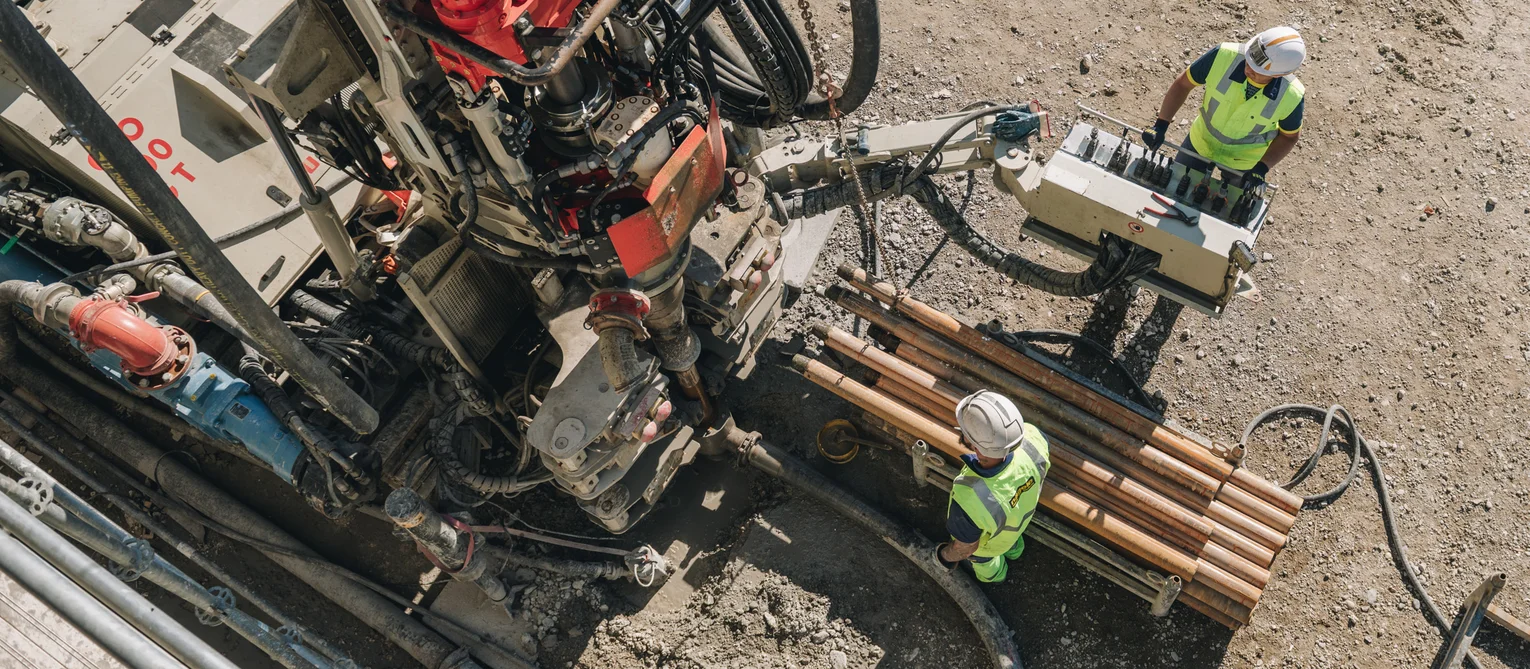
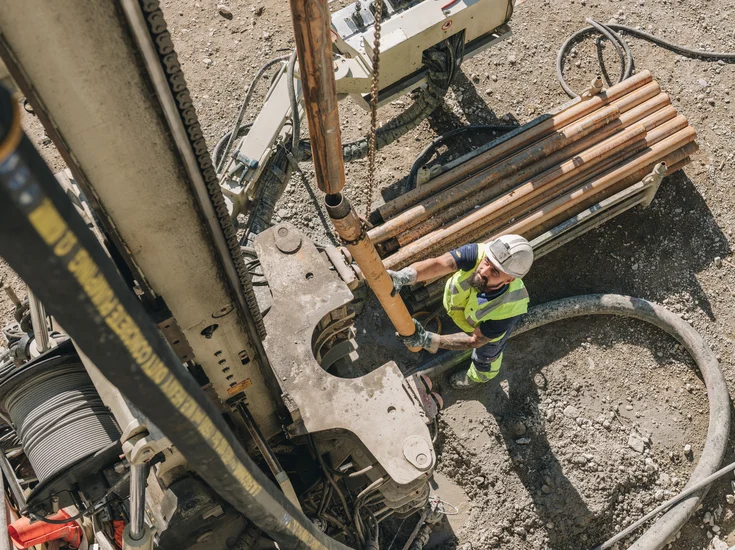
Hydraulic drilling rigs are used to drill to the required depth. Depending on the geological conditions, one of the following two methods is used:

a) Down-the-hole hammer drilling method

In solid rock, blocky or coarse gravel soils, the boreholes are drilled to the required depth using the down-the-hole hammer drilling method. Compressed air generated by a compressor flows through the drill pipe to the hammer. With a high impact rate of approximately 600 blows per minute, the hammer breaks up the surrounding material.

The drill cuttings are then also brought to the surface through the annular space with the aid of compressed air.

In loose rock, also known as overburden, auxiliary casing is installed at the same time as the drill pipe. This prevents the borehole from collapsing and ensures that the geothermal probes can be installed safely after the drill pipe has been removed.

b) Direct flush drilling method

In the direct flush drilling method, instead of additional auxiliary casing, a thick flush with a high specific weight is used to stabilise the borehole wall.

The rotating movement of the drill string and the high specific weight of the flushing fluid press a thin clay film onto the borehole wall. This is known as the filter cake. The circulating flushing fluid creates excess pressure in the borehole. This keeps the borehole wall stable even without auxiliary casing.

The flushing fluid is sucked out of the flushing tank by a pump and pressed down through the drill pipe. The drilling tool, e.g. roller bit or wing bit, is screwed onto the lower end of the drill pipe. The pressurised flushing fluid helps the drilling tool to loosen the soil and convey it upwards through the annular space. The drill cuttings settle in the settling tank. Repeating this process creates a flushing cycle.

After sinking the borehole and pulling the drill pipes, the geothermal probes are installed. Two plastic U-shaped pipes are generally used. These are therefore also referred to as double U-probes.

To ensure the flow of heat from the ground to the plastic pipes filled with brine, the borehole is grouted from the bottom of the probe upwards using a special heat-conductive mortar. This seal also prevents the individual groundwater horizons from connecting.

The horizontal connection refers to the connection between the heat pump in the building and the ground probe borehole in the ground. Here, we take care of the necessary distribution system and the connecting pipes that need to be laid to the geothermal probe. Our trained staff then fill the pipes with the heat-transfer medium and carry out a pressure and flow test.

Once commissioning has been successfully completed, your new energy source will be handed over to you ready for use.

Any questions? Contact us for further information or an individual quote.

Drilling techniques

Exploratory drilling
Exploration provides planning security

Soil investigations provide information about underground conditions, which can vary greatly even within a small area. Whether exploring deposits or planning projects of various sizes, our soil investigations provide genuine planning reliability. This allows us to avoid surprises later on during project implementation.

Areas of application for exploratory drilling:

  • Building site investigation (hydrogeology and engineering geology)
  • Contaminated site investigation
  • Developments for landfill sites
  • Exploration of deposits

     
Exploratory drilling

Penetrometer tests

We offer a fast and cost-effective method of investigating the subsoil using dynamic probing. This involves driving a rod into the ground with a specified amount of energy. The number of blows required to achieve the necessary penetration depth is recorded and plotted on a step diagram. This allows us to draw conclusions about the density of the underlying subsoil.

Drilling techniques

Well drilling
The way to your water reservoir

Groundwater can be used for a variety of purposes. As specialists in well drilling, we work for both private and public clients.

Our range of services
Well construction sector

Wells for groundwater heat pumps

Well for drinking water extraction

Drilling for groundwater monitoring wells